$55.39
Arming the Nation for War—
$55.39
The Story
A decorated World War I veteran, Federal Judge Robert P. Patterson knew all too well the needs of soldiers on the battlefield. He was thus dismayed by America’s lack of military preparedness when a second great war engulfed Europe in 1939–40. With the international crisis worsening, Patterson even resumed military training—as a forty-nine-year old private—before being named assistant secretary of war in July 1940. That appointment set the stage for Patterson’s central role in the country’s massive mobilization and supply effort which helped the Allies win World War II.
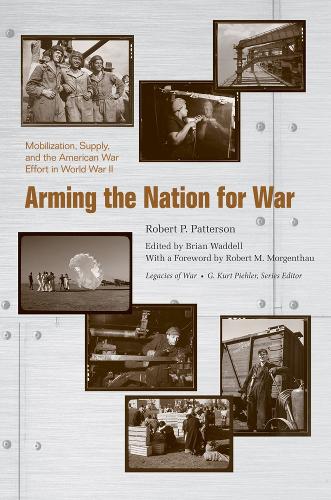
In Arming the Nation for War, a previously unpublished account long buried among the late author’s papers and originally marked confidential, Patterson describes the vast challenges the United States faced as it had to equip, in a desperately short time, a fighting force capable of confronting a formidable enemy. Brimming with data and detail, the book also abounds with deep insights into the myriad problems encountered on the domestic mobilization front—including the sometimes divergent interests of wartime planners and industrial leaders—along with the logistical difficulties of supplying far-flung theaters of war with everything from ships, planes, and tanks to food and medicine. Determined to remind his contemporaries of how narrow the Allied margin of victory was and that the war’s lessons not be forgotten, Patterson clearly intended the manuscript (which he wrote between 1945 and ’47, when he was President Truman’s secretary of war) to contribute to the postwar debates on the future of the military establishment. That passage of the National Security Act of 1947, to which Patterson was a key contributor, answered many of his concerns may explain why he never published the book during his lifetime.
A unique document offering an insider’s view of a watershed historical moment, Patterson’s text is complemented by editor Brian Waddell’s extensive introduction and notes. In addition, Robert M. Morgenthau, former Manhattan district attorney and a protégé of Patterson’s for four years prior to the latter’s death in a 1952 plane crash, offers a heartfelt remembrance of a man the New York Herald-Tribune called “an example of the public-spirited citizen.”
In Arming the Nation for War, a previously unpublished account long buried among the late author’s papers and originally marked confidential, Patterson describes the vast challenges the United States faced as it had to equip, in a desperately short time, a fighting force capable of confronting a formidable enemy. Brimming with data and detail, the book also abounds with deep insights into the myriad problems encountered on the domestic mobilization front—including the sometimes divergent interests of wartime planners and industrial leaders—along with the logistical difficulties of supplying far-flung theaters of war with everything from ships, planes, and tanks to food and medicine. Determined to remind his contemporaries of how narrow the Allied margin of victory was and that the war’s lessons not be forgotten, Patterson clearly intended the manuscript (which he wrote between 1945 and ’47, when he was President Truman’s secretary of war) to contribute to the postwar debates on the future of the military establishment. That passage of the National Security Act of 1947, to which Patterson was a key contributor, answered many of his concerns may explain why he never published the book during his lifetime.
A unique document offering an insider’s view of a watershed historical moment, Patterson’s text is complemented by editor Brian Waddell’s extensive introduction and notes. In addition, Robert M. Morgenthau, former Manhattan district attorney and a protégé of Patterson’s for four years prior to the latter’s death in a 1952 plane crash, offers a heartfelt remembrance of a man the New York Herald-Tribune called “an example of the public-spirited citizen.”
Description
A decorated World War I veteran, Federal Judge Robert P. Patterson knew all too well the needs of soldiers on the battlefield. He was thus dismayed by America’s lack of military preparedness when a second great war engulfed Europe in 1939–40. With the international crisis worsening, Patterson even resumed military training—as a forty-nine-year old private—before being named assistant secretary of war in July 1940. That appointment set the stage for Patterson’s central role in the country’s massive mobilization and supply effort which helped the Allies win World War II.
In Arming the Nation for War, a previously unpublished account long buried among the late author’s papers and originally marked confidential, Patterson describes the vast challenges the United States faced as it had to equip, in a desperately short time, a fighting force capable of confronting a formidable enemy. Brimming with data and detail, the book also abounds with deep insights into the myriad problems encountered on the domestic mobilization front—including the sometimes divergent interests of wartime planners and industrial leaders—along with the logistical difficulties of supplying far-flung theaters of war with everything from ships, planes, and tanks to food and medicine. Determined to remind his contemporaries of how narrow the Allied margin of victory was and that the war’s lessons not be forgotten, Patterson clearly intended the manuscript (which he wrote between 1945 and ’47, when he was President Truman’s secretary of war) to contribute to the postwar debates on the future of the military establishment. That passage of the National Security Act of 1947, to which Patterson was a key contributor, answered many of his concerns may explain why he never published the book during his lifetime.
A unique document offering an insider’s view of a watershed historical moment, Patterson’s text is complemented by editor Brian Waddell’s extensive introduction and notes. In addition, Robert M. Morgenthau, former Manhattan district attorney and a protégé of Patterson’s for four years prior to the latter’s death in a 1952 plane crash, offers a heartfelt remembrance of a man the New York Herald-Tribune called “an example of the public-spirited citizen.”
In Arming the Nation for War, a previously unpublished account long buried among the late author’s papers and originally marked confidential, Patterson describes the vast challenges the United States faced as it had to equip, in a desperately short time, a fighting force capable of confronting a formidable enemy. Brimming with data and detail, the book also abounds with deep insights into the myriad problems encountered on the domestic mobilization front—including the sometimes divergent interests of wartime planners and industrial leaders—along with the logistical difficulties of supplying far-flung theaters of war with everything from ships, planes, and tanks to food and medicine. Determined to remind his contemporaries of how narrow the Allied margin of victory was and that the war’s lessons not be forgotten, Patterson clearly intended the manuscript (which he wrote between 1945 and ’47, when he was President Truman’s secretary of war) to contribute to the postwar debates on the future of the military establishment. That passage of the National Security Act of 1947, to which Patterson was a key contributor, answered many of his concerns may explain why he never published the book during his lifetime.
A unique document offering an insider’s view of a watershed historical moment, Patterson’s text is complemented by editor Brian Waddell’s extensive introduction and notes. In addition, Robert M. Morgenthau, former Manhattan district attorney and a protégé of Patterson’s for four years prior to the latter’s death in a 1952 plane crash, offers a heartfelt remembrance of a man the New York Herald-Tribune called “an example of the public-spirited citizen.”