The Story
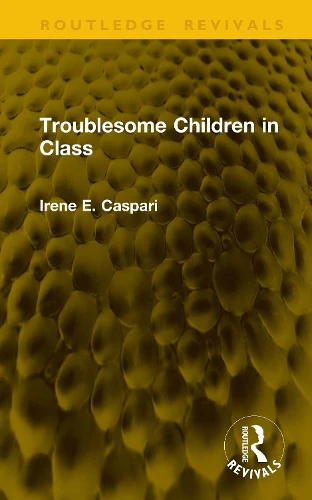
First published in 1976, Troublesome Children in Class is an authoritative account of a problem at the forefront of the minds of all teachers and students going into teaching. The author approaches the problem of troublesome children in class with great sympathy and understanding. She treats troublesome behaviour not as something to be stamped out by the force of discipline but as a problem to be understood widely and deeply in terms of the child’s individual predicament. She explores the teacher’s opportunities to help troublesome children and simultaneously to alleviate his own problems of class control.
Irene Caspari firstly looks at the stresses that schools as institutions place on teachers, children, and their parents, and the extent to which these stresses further or prevent growth and development. She then goes on to identify those troublesome children who need special help. In the final and major part of the book, the teacher’s contribution to helping these children is explored. His interventions are seen in terms of his understanding of the children’s behaviour and of the child-teacher relationship with particular emphasis on his insight into the children’s feelings and into his own. At the same time stress is laid on the importance of the teacher’s competence in teaching techniques.
Description
First published in 1976, Troublesome Children in Class is an authoritative account of a problem at the forefront of the minds of all teachers and students going into teaching. The author approaches the problem of troublesome children in class with great sympathy and understanding. She treats troublesome behaviour not as something to be stamped out by the force of discipline but as a problem to be understood widely and deeply in terms of the child’s individual predicament. She explores the teacher’s opportunities to help troublesome children and simultaneously to alleviate his own problems of class control.
Irene Caspari firstly looks at the stresses that schools as institutions place on teachers, children, and their parents, and the extent to which these stresses further or prevent growth and development. She then goes on to identify those troublesome children who need special help. In the final and major part of the book, the teacher’s contribution to helping these children is explored. His interventions are seen in terms of his understanding of the children’s behaviour and of the child-teacher relationship with particular emphasis on his insight into the children’s feelings and into his own. At the same time stress is laid on the importance of the teacher’s competence in teaching techniques.